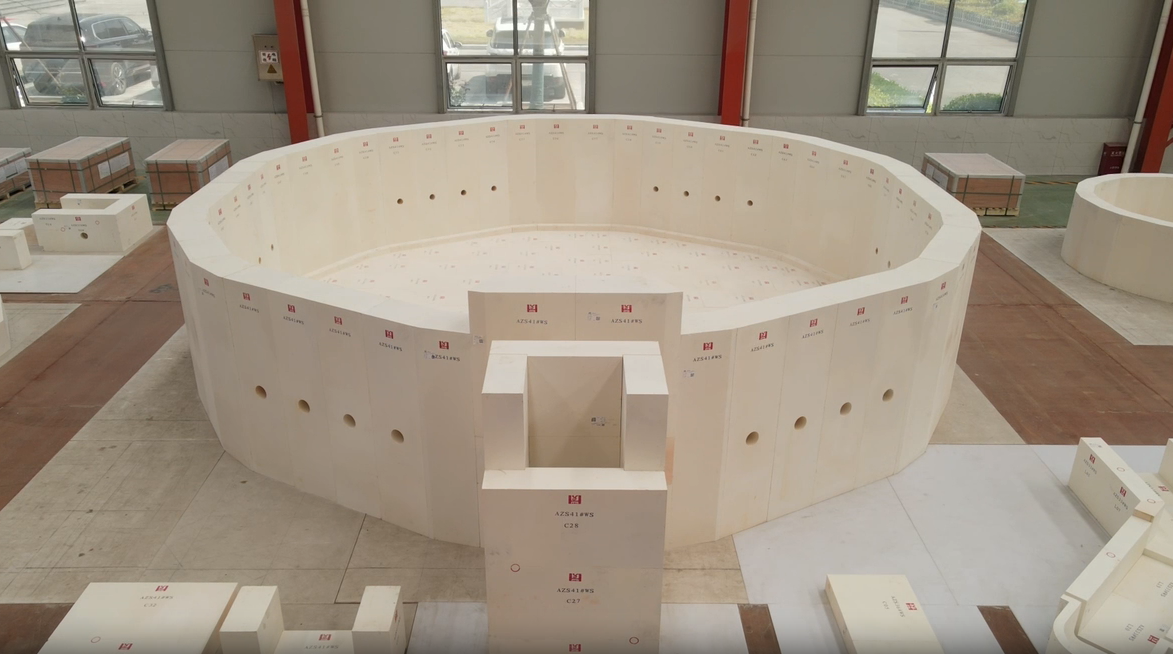
Fused cast AZS bricks, short for fused cast alumina-zirconia-silica refractory bricks, are premium fused refractory materials composed of Al₂O₃, ZrO₂ and SiO₂ as the main chemical components. Thanks to their ultra-dense microstructure, exceptional molten glass corrosion resistance and excellent high-temperature structural stability, fused cast AZS bricks have become the core lining materials for modern high-temperature glass melting furnaces. This article systematically elaborates on raw material composition, production technology, core physical and chemical properties, mainstream product grades, typical industrial applications and future development trends of fused cast AZS bricks, aiming to provide a comprehensive reference for the selection, application and technical upgrading of refractory materials in high-temperature kiln industries.
1. Introduction
High-temperature industrial kilns, especially glass melting furnaces, operate under extremely harsh working conditions: long-term high temperature above 1500℃, strong chemical erosion from alkaline molten glass, frequent thermal shock caused by periodic temperature fluctuation, and mechanical scouring from flowing glass liquid. Traditional sintered refractory bricks cannot withstand such severe service environments, suffering from rapid erosion, material peeling and molten glass penetration, which greatly shortens the service life of kilns and contaminates glass products.
Fused cast AZS bricks were developed to solve the bottleneck of refractory materials for glass furnaces. Different from conventional sintered refractories produced by pressing and high-temperature sintering, AZS bricks adopt electric arc furnace high-temperature fusion and integral casting molding technology. With zircon sand and industrial pure alumina powder as core raw materials, these products integrate the advantages of three oxide components, and fill the performance gap of ordinary refractory materials in high-temperature corrosive environments. At present, fused cast AZS bricks occupy more than 80% of the refractory lining market for medium and large-scale glass melting furnaces worldwide, becoming an indispensable foundational material for the glass manufacturing industry.
2. Raw Material Composition and Classification
2.1 Core Chemical Components
The abbreviation AZS corresponds to its three key oxide components: Alumina (Al₂O₃), Zirconia (ZrO₂) and Silica (SiO₂). High-quality fused cast AZS bricks are produced with high-purity raw materials, without excessive harmful impurities such as iron oxide and alkali metal oxides that may pollute molten glass. Each component undertakes unique functional roles:
Zirconia (ZrO₂): The core functional component of AZS bricks. It forms a dense protective layer when reacting with alkaline molten glass, effectively blocking the penetration and erosion of glass liquid. It also endows bricks with outstanding thermal shock resistance through phase transformation toughening.
Alumina (Al₂O₃): Improves the high-temperature refractoriness and mechanical compressive strength of bricks, maintaining stable structural performance under long-term ultra-high temperature working conditions.
Silica (SiO₂): Optimizes the microstructure of fused cast bricks, reduces internal porosity, and matches the physical and chemical properties of molten glass to minimize glass product contamination.
2.2 Mainstream Product Grades
According to the mass fraction of zirconia, fused cast AZS bricks are divided into three mainstream grades for differentiated kiln working zones:
AZS-33#: ZrO₂ content stably controlled at 33%. It is the most widely used general-grade product, with balanced cost and performance, suitable for furnace superstructure, flue walls and other parts not directly contacted by a large amount of flowing molten glass.
AZS-36#: Medium-grade product with 36% zirconia content. It has enhanced glass corrosion resistance, applied for furnace side walls, pool bottom pavements and forehearth channels that are directly exposed to molten glass.
AZS-41#: High-end premium grade with 41% zirconia content. It features the strongest erosion resistance and ultra-low glass exudation performance, specially used for key severely eroded parts such as furnace doghouse, feeder openings and molten glass impact zones.
3. Production Process of Fused Cast AZS Bricks
The whole production process of fused cast AZS bricks is strictly controlled to ensure low porosity and dense microstructure, which is fundamentally different from sintered refractory bricks. The standardized production flow is as follows:
3.1 Raw Material Batching and Mixing
High-purity zircon sand and alumina powder are proportioned accurately according to the target grade. Trace mineralizers are added appropriately to optimize melting efficiency, and all raw materials are fully and evenly mixed to avoid component segregation in subsequent melting.
3.2 High-temperature Electric Melting
The mixed raw materials are sent to a three-phase electric arc furnace, and melted at an ultra-high temperature above 1900℃. The raw materials are completely transformed into homogeneous liquid melt without solid particles, laying a foundation for dense brick structure.
3.3 Integral Casting and Controlled Cooling
The high-temperature molten liquid is poured into prefabricated sand molds or metal molds according to customized brick shapes. Slow and staged cooling is adopted to eliminate internal thermal stress. This controlled cooling process prevents crack generation caused by rapid temperature change during solidification.
3.4 Annealing, Cutting and Finishing
After complete solidification, rough bricks undergo long-time annealing treatment to further release residual stress. Finally, surface cutting, size finishing and quality inspection are carried out to obtain finished fused cast AZS bricks with accurate dimensions and stable performance.
4. Core Advantages and Physical & Chemical Properties
Compared with sintered refractory bricks and other fused refractory products such as alumina fused bricks, fused cast AZS bricks possess irreplaceable comprehensive advantages:
4.1 Ultra-low Porosity and Dense Structure
Thanks to integral fusion casting molding, the apparent porosity of qualified AZS bricks is lower than 1%, far less than 15%-25% porosity of sintered refractories. The dense internal structure completely blocks capillary penetration of molten glass, avoiding internal erosion failure of bricks.
4.2 Excellent Molten Glass Corrosion Resistance
Zirconia inside bricks can react with alkaline components in molten glass to form a compact inert protective film on the brick surface, which inhibits continuous erosion. Its service life is 3 to 5 times longer than that of traditional sintered refractory bricks in glass furnace working environments.
4.3 Low Pollution to Glass Products
Fused cast AZS bricks have extremely low glass exudation, stone and bubble generation rate during high-temperature operation. They will not introduce impurities into molten glass, which guarantees the high transparency and surface quality of finished glass, especially suitable for high-end photovoltaic glass and automotive glass production lines.
4.4 Good Thermal Shock Resistance and High-temperature Mechanical Strength
The phase transformation of zirconia can absorb thermal stress generated by rapid temperature rise and fall, preventing brick peeling and cracking. Meanwhile, the bricks maintain high compressive strength above 1500℃, resisting mechanical scouring from flowing high-temperature molten glass.
5. Industrial Application Scenarios
5.1 Glass Melting Furnace (Core Application)
More than 90% of fused cast AZS bricks are applied to all structural parts of various glass melting furnaces, including float glass furnaces, daily-use glass furnaces, pharmaceutical glass furnaces, photovoltaic glass and electronic glass furnaces. Specific lining positions include furnace side walls, tank bottom, forehearth, superstructure, feeder channels and crowns. The application of AZS bricks can extend the overall service life of glass furnaces from 4-5 years to 8-12 years, greatly reducing kiln maintenance and replacement costs.
5.2 Other High-temperature Industrial Kilns
Ceramic sintering kilns: Lining materials for high-temperature zones resistant to alkaline flue gas erosion;
Metallurgical refining furnaces: Local lining of ladles and secondary refining furnaces contacting molten alloy;
Special high-temperature kilns: Industrial furnaces for electronic component annealing and frit production.
6. Existing Defects and Future Development Trends
6.1 Current Limitations
Despite outstanding comprehensive performance, fused cast AZS bricks still have shortcomings: high production energy consumption due to ultra-high-temperature melting process; partial component segregation existing in large-size cast bricks; and high raw material cost restricted by zircon sand resource prices.
6.2 Future Technical Development Directions
Low-carbon and Energy-saving Production: Optimize electric arc furnace melting technology and adopt waste heat recovery systems to reduce production power consumption and realize green manufacturing;
Microstructure Optimization: Adopt fine grain homogenization casting technology to eliminate component segregation and further reduce brick exudation for ultra-high-end glass production;
Composite Modified AZS Bricks: Add rare earth oxide additives to further improve thermal shock resistance and high-temperature creep resistance, adapting to larger-capacity and longer-cycle glass furnaces;
Recycling Technology: Develop harmless recycling and reprocessing technology for waste AZS bricks to improve resource utilization rate and reduce industrial solid waste emissions.


